


In this article 1. The LinkedIn Guilt Complex Nobody Talks About
In this article:
SHARE THIS


It’s 4pm on a Tuesday. You’ve been in back-to-back meetings since 9am. Your inbox shows 47 unread emails. The sales team is asking about those new case studies. Your CEO just forwarded another “Why aren’t we posting on LinkedIn like [competitor]?” email.
And your company’s LinkedIn page? Last post: 6 weeks ago. A generic industry article you shared in a shame spiral between meetings.
You know you should be posting consistently. You know LinkedIn matters for B2B. You know your competitors are showing up daily with polished content, team spotlights, and project updates that make their companies look thriving and relevant.
But knowing and doing are two very different things when you’re a marketing department of one.
The LinkedIn Guilt Complex Nobody Talks About
Here’s the truth that most marketing advice conveniently ignores: that “post 3-5 times per week” guidance assumes you have time to breathe. Those competitor posts that look effortless? They probably have an agency or a dedicated social media person. And that guilt you feel about deprioritizing LinkedIn? It’s completely valid because it does matter for B2B pipeline development.
But here’s what we’ve learned working with B2B companies where marketing is a department of one: The problem isn’t that you don’t understand LinkedIn’s importance. The problem is that every “just post consistently” guide ignores your actual reality.
Your reality looks like this:
- Website updates that can’t wait
- Sales collateral that’s urgently needed
- Trade show preparation that’s only a couple of weeks out
- Email campaigns that need to launch
- Analytics reports the leadership team wants yesterday
- A CRM that needs attention
- And somewhere in there, a consistent LinkedIn presence that keeps sliding to the bottom of the list
Sound familiar?
You’re not failing at LinkedIn. You’re succeeding at prioritizing work that has immediate business impact. The challenge is that LinkedIn’s impact is cumulative and delayed, which makes it easy to deprioritize when everything else feels urgent.
Why Your LinkedIn Page Actually Matters (The Business Case You Can Take to Your CEO)
Before we talk about what to post, let’s establish why this deserves any of your limited time at all. Because if you’re going to fight for two hours in your calendar, you need to know it’s worth fighting for.
Your LinkedIn Page Is Your Digital Front Door
When someone researches your company before a sales call, after a trade show conversation, or because they saw your name mentioned somewhere, they’re probably going to LinkedIn. Your company page is often the first impression after your website, and sometimes it’s the first impression period.
Here’s what happens when prospects land on your page and see your last post was two months ago:
They wonder:
- Are they still in business?
- Is their team overwhelmed or understaffed?
- Do they actually understand modern B2B marketing?
- Should I trust them with my budget?
They assume:
- The company might not be stable
- They’re probably behind on industry trends
- Working with them might mean outdated approaches
- My competitors who are active on LinkedIn might be better choices
The Ghost Town Effect Is Real
An inactive LinkedIn page doesn’t just fail to help you. It actively works against you. In B2B, where trust and credibility drive decisions worth tens or hundreds of thousands of dollars, every signal matters. And an abandoned LinkedIn page signals exactly what you don’t want it to signal.
The Pipeline Connection You Can Measure
Here’s the sequence that actually happens:
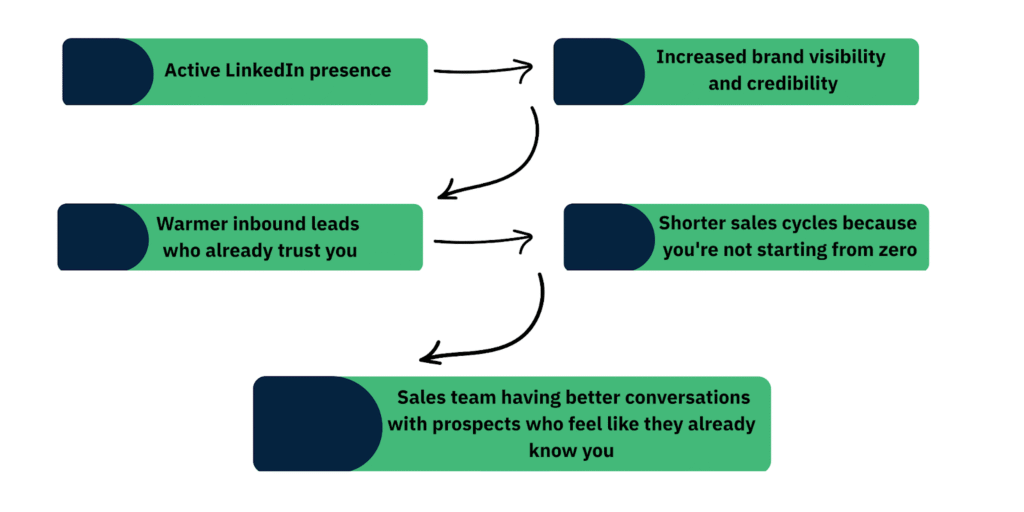
We’ve seen this pattern repeatedly with clients who finally got their LinkedIn presence consistent:
- Manufacturing company, solo marketer: Went from posting quarterly to twice monthly using a simple system. Within three months, their sales team reported prospects saying “I’ve been following you on LinkedIn” in first calls. The conversations started warmer. The sales cycle shortened.
- Professional services firm: The CEO stopped getting “why aren’t we on LinkedIn?” questions from board members. Started getting “I saw your post about [project]” messages from prospects instead. LinkedIn went from a source of guilt to a source of qualified conversations.
- Industrial distributor: Committed to posting employee stories twice monthly. Six months later, their HR director reported that every new hire mentioned seeing the company’s LinkedIn posts as part of their decision to apply. LinkedIn presence was recruiting for them while they slept.
You’re not maintaining a LinkedIn presence for vanity metrics or engagement counts. You’re maintaining it because every week you’re silent is a week your competitors look more credible, more active, and more trustworthy than you. And in B2B, trust is currency.
The Time-Reality Framework: What Actually Works When You Have 2 Hours Per Month
Let’s be brutally honest about your time budget.
You probably have 2-3 hours per month you could dedicate to LinkedIn if nothing catches fire. You have zero bandwidth for “content creation” in the traditional sense. You don’t have budget for fancy graphics or professional photography. And you certainly don’t have time to become a LinkedIn expert, track algorithm changes, or experiment with trending formats.
But here’s what you do have: an internal library of work you’ve already done. Case studies sitting in folders. Project photos on people’s phones. Team wins that happened but never got shared. Client success stories that your sales team knows but your market doesn’t.
The content already exists. It’s just not on LinkedIn yet.
The 80/20 Rule for Overwhelmed Marketers
Here’s the pattern we’ve observed across hundreds of B2B companies: 80% of your LinkedIn results will come from 20% of post types.
Those two types? Employee stories and project stories.
Why these two types consistently outperform everything else:
1. You already have the content – No creation needed, just curation from work already happening
2. They require minimal polish – Authenticity beats perfection on LinkedIn every single time
3. They’re evergreen – You’re not chasing trends, news cycles, or algorithm changes
4. They drive actual business results – People buy from people, and these posts prove your expertise through real work
Every other post type (industry news, thought leadership, tips and tricks, motivational quotes, trending topics) requires more time, more creative energy, and delivers less business impact. You don’t have time for high-effort, low-return content. You need high-return content that fits into the margins of your already-full calendar.
The Realistic Posting Cadence
Forget “post daily” or “3-5 times per week.” That’s advice for companies with social media teams.
Here’s what actually works for solo marketers:
Minimum viable presence: Twice monthly (every other week)
- Keeps your page from looking abandoned
- Doesn’t overwhelm your capacity
- Builds consistency you can actually maintain
Optimal cadence: Eight times monthly (twice per week)
- Creates momentum and visibility
- LinkedIn’s algorithm rewards consistency at this level
- Still achievable when things get busy
Start with twice monthly. If that becomes easy, add more. But twice monthly that you actually execute beats four times monthly that you quit after six weeks.
Your Monthly Content Calendar in 2 Hours
Here’s the system that works within your constraints:
Hour 1: Content Gathering (Two 30-minute sessions, done biweekly)
Set a recurring calendar block every other Monday morning or Friday afternoon. Protect this time like you’d protect a client meeting.
During each 30-minute session:
- Text your team: “Send me any project wins, client feedback, or team moments from the last 2 weeks”
- Check your project management system for recently completed work
- Scan team Slack or email for celebrations, milestones, or problem-solving moments
- Look at your phone’s photo library for behind-the-scenes moments
- Review client communications for success stories worth sharing
Take notes. Save photos to a dedicated folder. You’re not writing yet, just collecting raw material.
Hour 2: Content Creation (Two 30-minute sessions, done biweekly)
During each 30-minute session:
- Pick one employee story and one project story from your gathered material
- Use the Story-Proof-Value-Invitation framework (detailed below)
- Write both posts in one sitting while the context is fresh
- Schedule them using LinkedIn’s native scheduler
- Done
Two hours per month. Four posts scheduled. LinkedIn presence maintained.
The key is protecting that time. Block it on your calendar. Treat it like a client meeting. Because consistent LinkedIn presence is a client meeting – it’s meeting with every prospect who’s researching you before they ever contact sales.
The Two Post Types That Do All the Heavy Lifting
Post Type 1: Employee Stories
Why they work:
Employee stories humanize your brand without corporate speak. They generate organic engagement because tagged employees share and comment, which exponentially increases your reach. They require zero design skills because candid photos outperform stock images. And they show company culture, which attracts both customers and talent.
When someone sees your employee story, they’re not seeing marketing. They’re seeing real people doing real work. That’s magnetic in a B2B landscape full of corporate polish and carefully crafted brand messaging.
What to post:
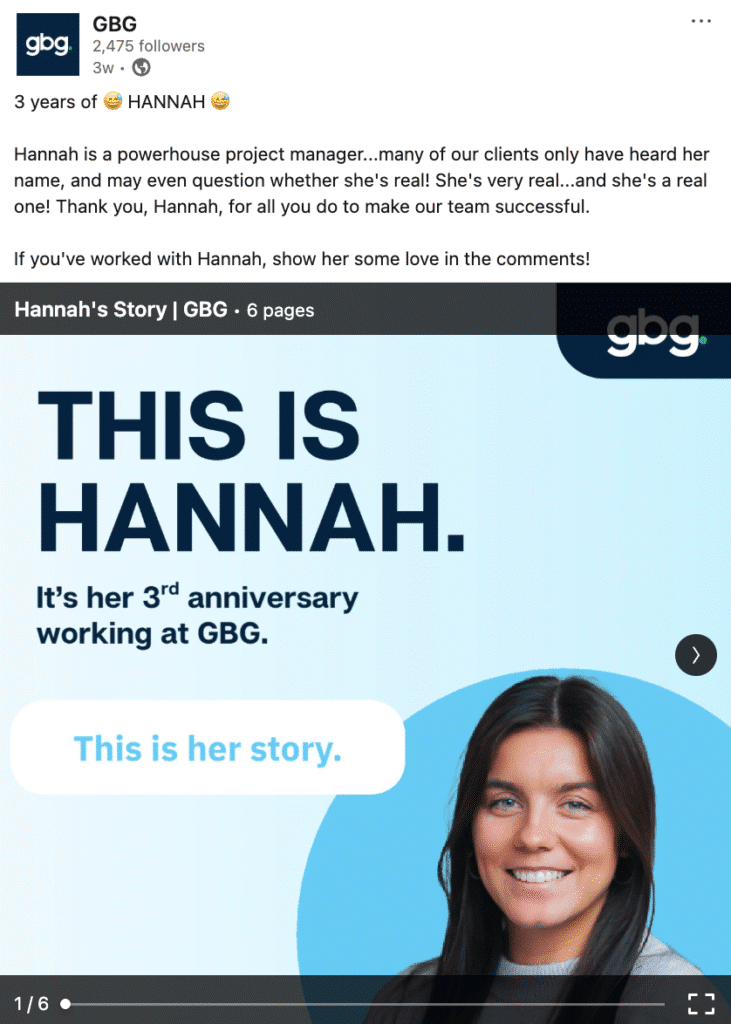
Work anniversaries: Your secret weapon for consistent content
- “Five years ago, Sarah joined our engineering team fresh out of college. This week, she led the technical review for our largest client project to date. What started as entry-level CAD work evolved into the kind of technical leadership that makes complex projects look easy. That’s what we mean when we say we invest in our people’s growth. Congrats, Sarah. Here’s to the next five years.”
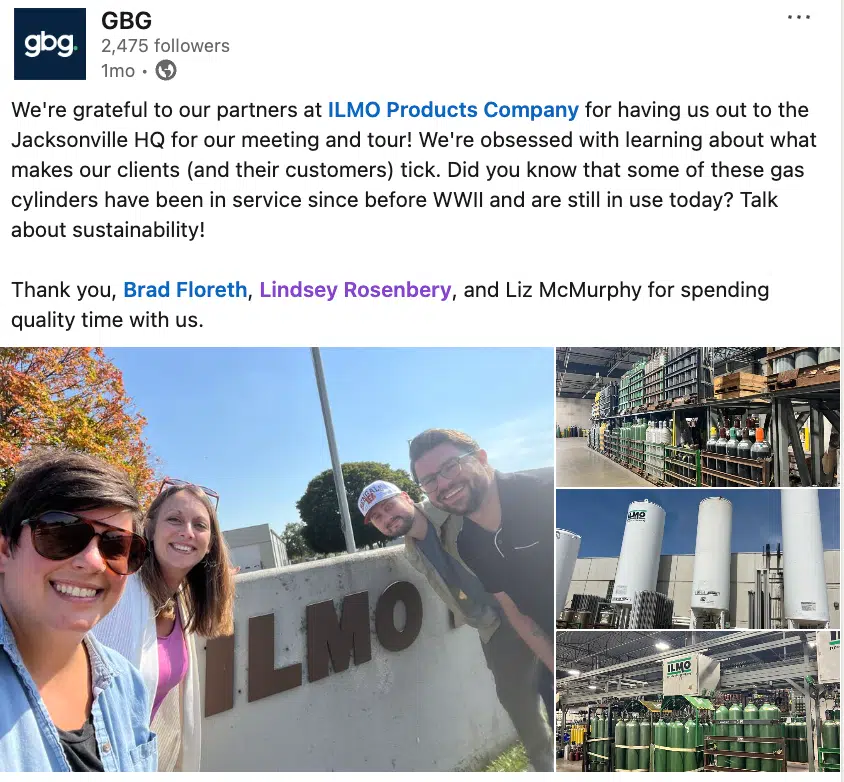
Behind the scenes: The moments that show how work actually happens
- “Setting up for the National Manufacturing Trade Show this morning. Our team’s superpower? The ability to transform a 10×10 booth space into something that actually makes people stop and ask questions. Three hours of setup, three days of great conversations with potential clients. This is where relationships start.”
Team wins: Celebrations that show your values in action
- “Shoutout to our production team who just completed their 500th custom order without a single quality issue. In an industry where precision matters and mistakes are expensive, this kind of consistency doesn’t happen by accident. It happens when you hire people who take pride in their craft.”
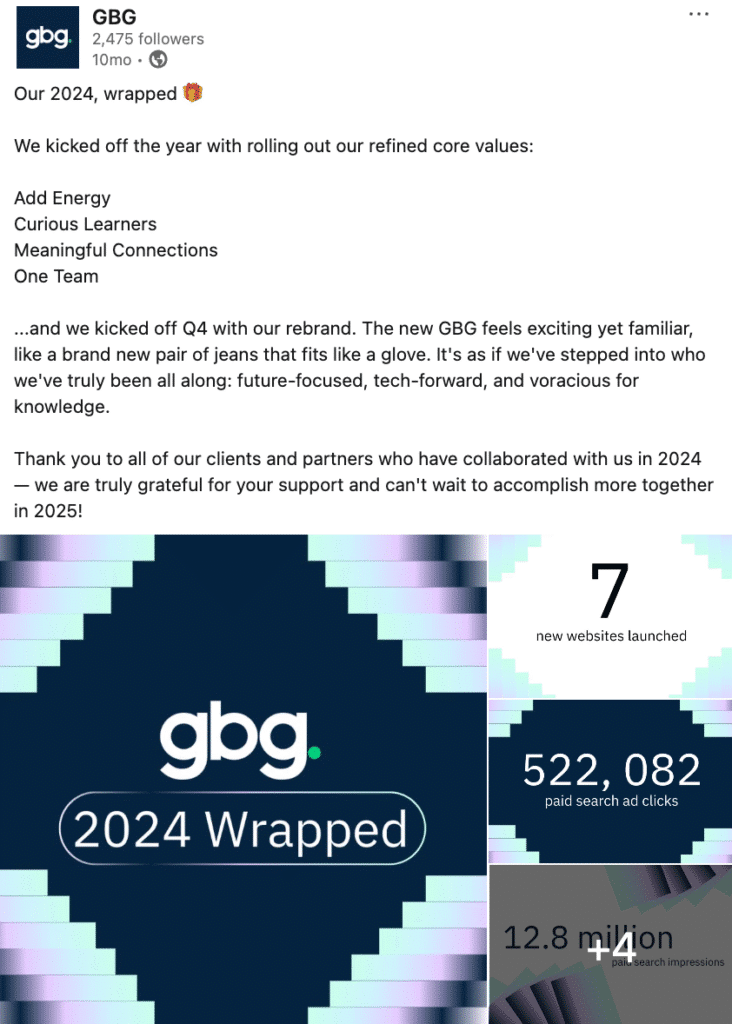
The framework for every employee post:
- Open with the human moment – The anniversary, the behind-the-scenes photo, the specific achievement
- Add context that matters – Why this is significant, what it took to get here, what it demonstrates
- Connect to company value – What this says about how you operate, what you prioritize, who you are
- Tag the employee – This multiplies engagement when they share with their network
Pro tip: Take photos at company events, during project work, at team meetings. Keep them in a folder labeled “LinkedIn Content.” When it’s time to post, you’ll have real images instead of scrambling for stock photos that look like every other B2B company.
Post Type 2: Project Stories
Why they work:
Project stories prove your expertise without feeling like bragging. They show what working with you actually looks like, which helps prospects visualize partnership. They create social proof your sales team can reference in conversations. And they give prospects a low-pressure reason to start a dialogue.
When someone reads your project story, they’re not reading a case study or a pitch. They’re seeing evidence of how you think, how you solve problems, and what results you deliver. That’s exactly what B2B buyers want before they ever reach out.
What to post:
Project completions: The finished work that demonstrates capability
- “We just wrapped a complete facility expansion project for a food processing client. The challenge: add 40% more production capacity without disrupting current operations. Our approach: phased implementation with weekend installations and parallel system testing. The result: new line fully operational, zero downtime, production targets exceeded by Week 2. In manufacturing, downtime is expensive. Planning that eliminates it is priceless.”
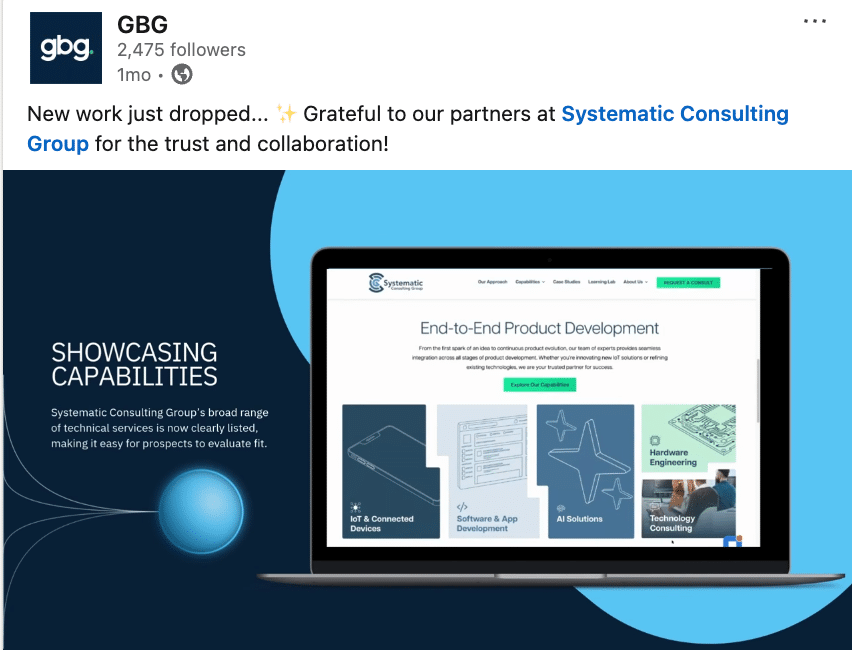
Problem-solving moments: The challenges that show how you think
- “Interesting challenge this week: A client needed to reduce their energy costs by 20% without compromising production output. The obvious solution (new equipment) was too expensive. The better solution: optimizing their existing systems through data analysis and operational adjustments. Sometimes the best engineering isn’t new technology. It’s better use of what’s already there.”
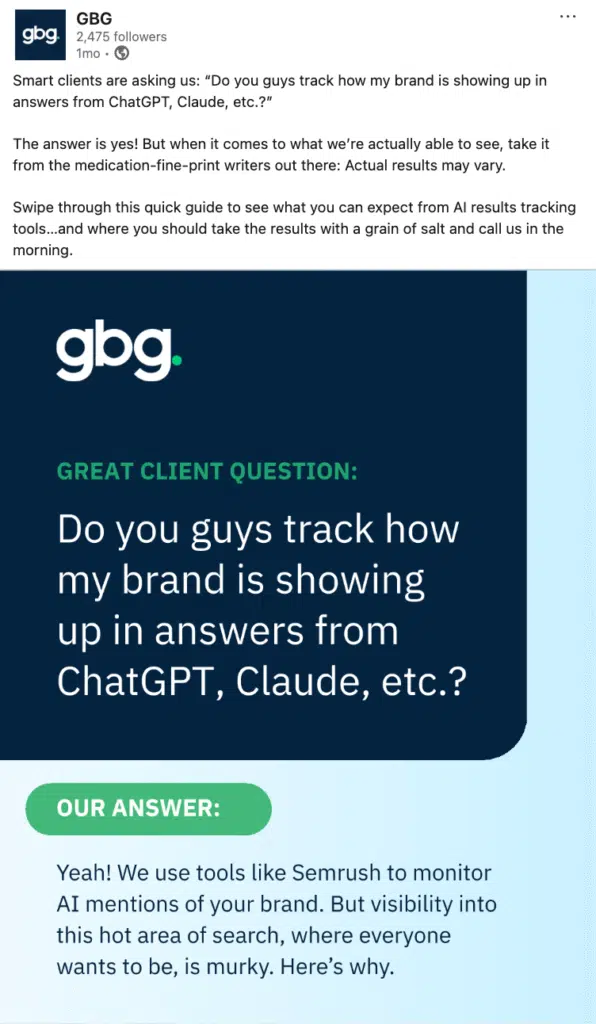
Lessons learned: The insights that position you as experts
- “After designing 50+ warehouse layouts, here’s what we’ve learned: The most efficient layout isn’t the one that maximizes square footage. It’s the one that minimizes touches. Every time someone picks up, moves, or handles a product, you’re adding cost and risk. The best warehouse designs eliminate unnecessary touches entirely. It’s not about space. It’s about flow.”
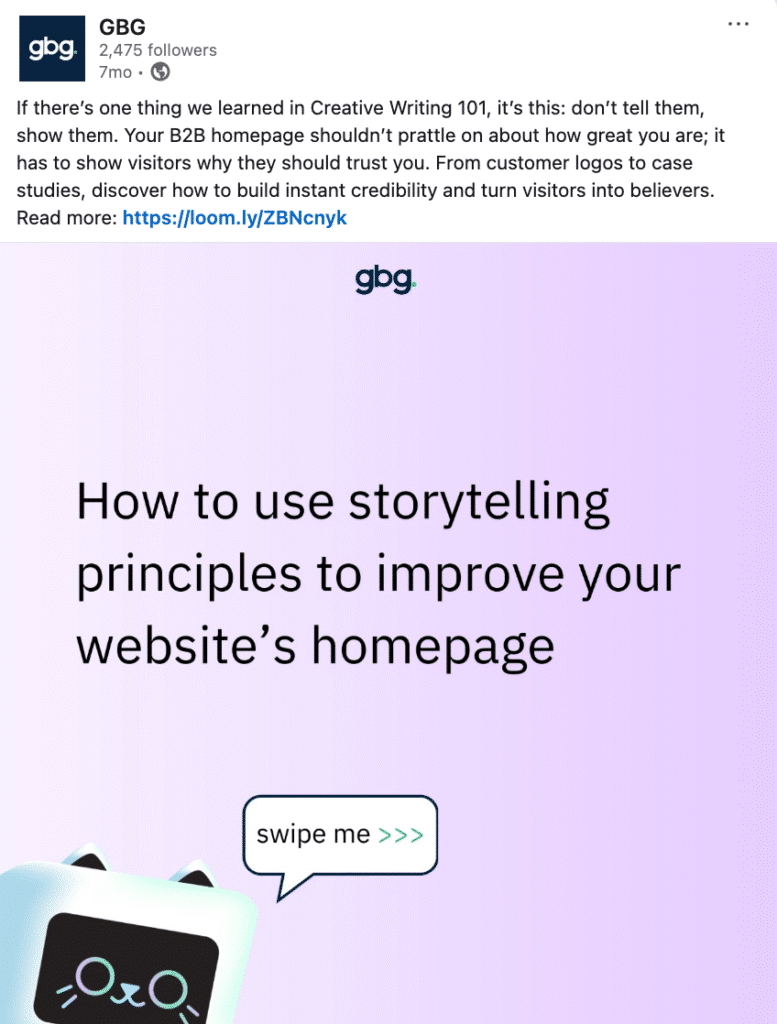
The framework for every project post:
- Set up the challenge – Be specific about the problem (specificity = credibility)
- Show your thinking – Explain your approach in a way that demonstrates expertise
- Reveal the outcome – Concrete results that prove capability
- Extract the lesson – The insight that provides value even to people who aren’t clients yet
Real example that performed well:
“Last month, a manufacturing client came to us frustrated. Their website was getting decent traffic, but zero leads. The sales team thought it was a design problem. It wasn’t.
The issue was positioning. They were talking about equipment specifications when buyers wanted to know about production outcomes. Technical details about their machines instead of business results for their clients.
We rebuilt their homepage messaging around customer results instead of product features. Same website. Same traffic. Different conversation.
Three weeks later: 40% increase in demo requests.
The lesson? In B2B, buyers don’t care about your product until they understand how it solves their specific problem. Lead with their outcome, not your features.”
This post works because:
- Opens with a relatable problem (traffic but no leads)
- Shows diagnostic thinking (it’s not what everyone assumed)
- Proves capability with specific results (40% increase)
- Ends with a principle readers can apply themselves (lead with outcomes)
You’re not just promoting your work. You’re teaching while you promote. That’s what makes project stories shareable and memorable.
The Reality Check: Why This Is Harder Than It Looks
Here’s what we’ve given you so far: a framework that actually works within your time constraints. A system that respects your reality as a solo marketer. A two-hour monthly commitment that can maintain consistent LinkedIn presence.
And if you implement this framework exactly as described, it will work. You will see results. Your page won’t look like a ghost town. Your sales team will start hearing “I follow you on LinkedIn” from prospects.
But here’s what we haven’t told you yet.
The Content Gathering Challenge
Getting consistent content from your team requires more than asking. It requires:
- A system for capturing moments as they happen – Not recreating them later when context is lost
- Buy-in from employees who don’t see social media as their job and won’t naturally think to send you content
- Protocol for the complications – Photo permissions, client confidentiality, brand guidelines, what’s appropriate to share and what isn’t
- Someone to remember to gather content regularly, even when everything else feels more urgent
Most companies start strong. Week 1: great content. Week 3: pretty good content. Week 6: scrambling because nobody sent anything and you forgot to ask. Week 8: posting stops because gathering content feels harder than it should.
The Writing Execution Reality
Even with a framework, each post requires:
- 15-30 minutes of focused writing and editing – That’s actual deep work time, not fragmented attention between meetings
- Understanding what LinkedIn’s algorithm rewards right now (it changes quarterly)
- Ability to write in your brand voice consistently – So your posts sound like your company, not like generic B2B marketing speak
- Skill to make B2B topics interesting without being salesy, corporate, or boring
- Strategic thinking about what stories resonate vs. what’s just noise that fills space
That 30-minute content creation session we described? That’s 30 minutes for someone who already knows how to do this. If you’re learning as you go, it’s closer to an hour. And when you’re tired at 4pm on Friday, that writing quality suffers.
The Consistency Trap
Here’s the pattern we see constantly:
- Weeks 1-6: You’re posting consistently. It feels good. Your CEO stops asking about LinkedIn. You’re building momentum.
- Weeks 7-8: Q4 gets crazy. Or a major client project demands attention. Or someone unexpectedly leaves and you’re covering their work. You miss two posts.
- Weeks 9-12: Your page looks semi-abandoned again. The guilt returns. You’ve lost momentum.
- Month 4: CEO sends another “why aren’t we posting consistently?” email. You’re back where you started.
This is where most solo marketers hit the wall.
The system works. The framework is sound. But execution requires three things most solo marketers don’t have:
- Protected time that doesn’t get hijacked when something “urgent” appears
- Creative energy you don’t always have at 4pm on Thursday
- Consistent follow-through even when your plate is overflowing with work that feels more immediately important
You’re not failing. The system is failing you by requiring a resource (consistent available time) that you don’t reliably have.
Your Three Paths Forward
So here’s where we get honest about what’s actually going to work for your situation.
Path 1: DIY with Our Framework
Best for: Companies where the solo marketer genuinely enjoys content creation and has capacity that won’t get constantly reallocated
What you need:
- This framework (you have it now)
- Calendar blocking that you can actually protect (treat it like client meetings)
- An internal system for content gathering (Slack channel, weekly team check-ins that actually happen)
- Realistic expectations (twice monthly minimum, four times monthly goal)
Success indicators:
- You can maintain posting for 3+ consecutive months without major gaps
- Your team actively contributes content ideas without constant prompting
- You enjoy the process, or at least don’t dread it
- LinkedIn doesn’t feel like one more obligation creating guilt
When to choose this path:
- You’ve successfully maintained other consistent marketing efforts
- You have genuine interest in social media strategy
- Your workload has predictable rhythms (not constant firefighting)
- Your leadership protects your time for marketing initiatives
Warning signs this won’t work:
- You’ve tried multiple times before without sustained success
- Your time gets reallocated constantly based on urgent needs
- You’re already overwhelmed with higher-priority work
- The thought of adding this makes you tired
Path 2: DIY with Strategic Support
Best for: Companies who want to own execution but need expert guidance to make it effective and sustainable
What this looks like:
- Quarterly strategy sessions to plan content themes aligned with business goals
- Monthly content calendar templates pre-populated with post ideas
- On-demand coaching for specific posts when you’re stuck
- Access to someone who knows what’s working on LinkedIn right now (because algorithms change and tactics evolve)
Why this works:
- You maintain control and ownership (important for brand voice)
- You keep costs significantly lower than full outsourcing
- You build your own capabilities over time (investment in your skills)
- You have expert backup when capacity gets tight (safety net without full dependency)
When to choose this path:
- You want to build internal capability, not just outsource
- You have some time, just not enough to figure everything out alone
- You need accountability and structure more than full execution
- Your budget allows for strategic consulting but not full service
What this costs (realistically):
- Strategy retainer: $1,500-3,000/month depending on support level
- Still requires 2-3 hours monthly of your execution time
- Provides expertise without removing the work from your plate
Path 3: Strategic Partnership (Full-Service Execution)
Best for: Companies where the solo marketer’s time is demonstrably worth more on strategic initiatives than social media execution
What this looks like:
- We interview your team monthly for content material (we do the gathering)
- We write, design, and schedule posts in your brand voice (we do the execution)
- We monitor engagement and adapt strategy based on performance (we optimize continuously)
- You review and approve before publishing (you maintain control)
- Your LinkedIn presence stays consistent even when Q4 hits, someone leaves, or priorities shift (reliability without dependency on your capacity)
Why companies choose this:
- Solo marketer’s time is legitimately worth more on strategic work, client projects, or revenue-driving initiatives
- Consistent presence happens without internal pressure, guilt, or constant reprioritization
- Expert execution that adapts to algorithm changes, industry trends, and performance data
- Predictable monthly investment vs. unpredictable time drain on already-limited capacity
Real talk from our clients:
“I spent six months trying to maintain LinkedIn myself. I’d post consistently for three weeks, then disappear for two months when things got busy. The guilt was worse than just admitting I needed help. Now it’s off my plate, our presence is actually consistent for the first time ever, and I can focus on the strategic projects that actually need my brain. Best decision I made this year.” – Marketing Director, Industrial Manufacturing Company
“We thought we couldn’t afford an agency. Then we calculated what my time was actually worth to the company, and realized we couldn’t afford NOT to get help. I was spending 4-5 hours monthly on LinkedIn and still missing posts. Now I spend 30 minutes monthly reviewing content, and our presence is 10x better than when I was doing it myself.” – Marketing Manager, Professional Services Firm
When to choose this path:
- You’ve tried DIY multiple times without sustained success
- Your strategic work delivers significantly more business value than tactical execution
- You want LinkedIn presence but don’t want to think about it weekly
- Your company values consistency and you need a system that doesn’t depend on your fluctuating capacity
- You’d rather invest budget than time (because you have more of the former)
What this costs (realistically):
- Full-service LinkedIn management: $2,000-4,000/month depending on posting frequency and complexity
- Removes 2-3 hours monthly from your workload permanently
- Provides expertise, execution, and consistency without adding to your responsibilities
What Most Companies Actually Need (And Won’t Admit)
Here’s the pattern we see constantly:
Solo marketers spend months feeling guilty about LinkedIn. They download frameworks. They block time on calendars. They have genuinely good intentions and actually understand what needs to happen.
And then reality hits.
The sales team needs new collateral for a pitch tomorrow. A trade show is coming up in three weeks. The website needs critical updates. The CEO has a new strategic initiative that requires marketing support. Email campaigns need to launch. Analytics reports are due.
LinkedIn gets deprioritized. Again.
Not because it doesn’t matter. Not because you don’t understand its importance. But because everything else feels more urgent right now, and urgency wins when you’re choosing between competing priorities with limited time.
The Pattern We See Every Time
Month 1-2: “I’m going to nail LinkedIn this time. I have a framework. I blocked time. I’m committed.”
Month 3-4: Posting becomes inconsistent. You miss a week. Then two weeks. Then a month.
Month 5-6: Your page goes dark again. The guilt returns. You stop looking at your company’s LinkedIn page because it makes you feel bad.
Month 7: CEO sends another “why aren’t we posting like [competitor]?” email. Or a board member mentions your inactive presence. Or a prospect mentions they looked for you on LinkedIn and you seemed quiet.
Month 8: The cycle restarts. New framework. New commitment. Same outcome.
If this sounds familiar, you’re not alone. This is the most common pattern we see with solo B2B marketers. And here’s what almost nobody admits:
If you’ve tried multiple times to maintain LinkedIn consistency and it hasn’t stuck, the problem isn’t your discipline. The problem isn’t your framework. The problem is you’re trying to solve it with a resource you don’t reliably have: consistent available time.
The Question to Ask Yourself
Think about your last 90 days. How many weeks did you have 2-3 hours of genuinely uninterrupted time to work on non-urgent strategic marketing initiatives?
- If the answer is “most weeks,” DIY might work for you.
- If the answer is “maybe 30% of weeks,” DIY with strategic support might bridge the gap.
- If the answer is “almost never,” you’re trying to solve a capacity problem with better tactics, which won’t work no matter how good the framework is.
When Strategic Partnership Makes Sense
You should seriously consider getting help when:
- You’ve tried DIY multiple times without sustained success beyond 2-3 months
- Your time is legitimately better spent on higher-level strategy, client work, or revenue-driving initiatives that only you can do
- You want LinkedIn presence but genuinely don’t want to think about it weekly (and that’s okay)
- Your company values consistency and you need a system that doesn’t depend on your fluctuating capacity
- The guilt and mental burden of maintaining LinkedIn yourself costs more than paying for help
- You’re the bottleneck for strategic marketing work because you’re spending time on tactical execution
When DIY Still Makes Sense
You should keep doing it yourself when:
- You genuinely enjoy social media content creation (some people do, and that’s great)
- You have protected time that reliably doesn’t get reallocated when things get busy
- Your team actively contributes content without constant prompting and follow-up
- You’re in a business phase where every dollar matters significantly more than time
- LinkedIn feels energizing rather than draining (this is rare, but if it’s you, lean into it)
- You’re building a skill you genuinely want to develop long-term (some marketers want to become LinkedIn experts)
There’s no wrong answer here. There’s only the honest assessment of what will actually work given your reality, not what should work in theory.
The Decision You Actually Need to Make
You opened this article looking for what to post on LinkedIn.
What you really needed to figure out: Is this something you’re realistically going to do, or something you need help with?
Both answers are completely valid. But continuing to pretend you’ll consistently execute something you haven’t been able to consistently execute before is the definition of insanity.
If you’re ready to own it yourself:
You have the framework now. Employee stories and project stories. Two hours per month. Story-Proof-Value-Invitation structure. Calendar blocks that you protect. A system for gathering content from your team. Twice monthly minimum, four times monthly goal.
Block the time right now. First and third Monday of every month, or whatever works for your calendar. Protect it like a client meeting. Start next week. Give yourself 90 days of consistent execution before deciding if this is sustainable long-term.
If you’ve tried this before and it didn’t stick:
Maybe the answer isn’t a better framework or more discipline. Maybe it’s admitting that your marketing brain is too valuable to spend on social media execution. There’s zero shame in that. It’s strategic resource allocation.
The world’s best marketing strategists don’t execute their own social media. They focus on strategy and let execution specialists handle consistent implementation. That’s not failure. That’s recognizing where your value actually lies.
Either way, the worst option is the one you’ve probably been living:
Feeling guilty about an inconsistent LinkedIn presence while not having the bandwidth to fix it. Cycling through frameworks and commitments that don’t stick. Disappointing yourself and your leadership repeatedly. That’s exhausting and unproductive.
Make the decision. Own it fully. Then stop feeling guilty and start making progress.
Ready to Stop Feeling Guilty About LinkedIn?
If you’ve read this far, you’re probably tired of the cycle. Tired of good intentions that don’t translate to consistent execution. Tired of feeling like you’re failing at something you know matters.
Here’s what we know after working with hundreds of solo B2B marketers:
- The ones who succeed with DIY: They protect time religiously, genuinely enjoy content creation, and have workloads with predictable rhythms.
- The ones who succeed with partnership: They admit that their strategic brain is worth more than their tactical execution, invest accordingly, and stop carrying guilt about something that’s off their plate.
- The ones who stay stuck: They keep trying the same approach expecting different results, or they avoid making any decision because both options feel imperfect.
We can help you figure out which path actually makes sense for your situation.
Book a 30-minute strategy call and we’ll have an honest conversation about:
- Whether DIY is realistically sustainable given your capacity
- What strategic support would look like if you want to own execution with expert guidance
- How full-service partnership would work if that’s the right fit
- No pressure to hire us – just honest assessment of what will actually work
Because the right LinkedIn strategy isn’t the one that sounds best in theory. It’s the one you’ll actually execute consistently.
And sometimes the bravest thing a solo marketer can do is admit they need help with execution so they can focus on strategy.
Your LinkedIn presence matters. Your time matters more. Let’s figure out how to solve for both!
Share this article with your network.