


In this article:
SHARE THIS


There is this scene in The Office where, at her art show, a vulnerable Pam overhears harsh criticism from Oscar’s partner Gil. He says her work lacks courage and likens it to “motel art.” Call me callous, but I agree with Gil. It stung for Pam to hear it, but her watercolor of a stapler has a lot in common with AI-generated blog content these days (some may call it AI slop): not much thought went into it, and it didn’t have anything particularly interesting to say.
Content marketing before AI was harder to do, but results came easier. It was a bluer ocean, but even a basic blog article took time and dedicated resources.
Today, anyone with an internet connection can produce a relatively cogent piece in seconds, so everyone has the resources to say the same things, and more people are saying them.
So if you don’t want to be Pam with nobody showing up to your art show (in other words, spend time creating and editing blog content that doesn’t get ranked, cited, or seen), you have to start taking more risks. One risk that can be worth taking is putting real answers to cost and pricing questions on your website. In this article, we’ll talk about why it can help you win at AI search and examine preliminary results of a client who has incorporated this into their content strategy.
| TL;DR for the “I’m not reading all that” crowd Generic AI content is like motel art. One way to stand out is to publish what your competitors hide: pricing. This article covers why AI tools cite pricing, the three fears that keep brands silent, and early results from a cost-focused content strategy for a GBG client. – People who ask cost questions want a number, so pages that state one have a better likelihood of getting cited. – The biggest fears about publishing prices shrink under scrutiny. Competitors hiding their prices may be invisible anyway, and early disqualification due to price can save sales teams’ tim – Elevate Outdoor’s cost-focused content is gaining fast visibility. AI Overview keywords on its site rose 182% in a year, and its paver cost page gained 71% more organic sessions after a refresh. Read on for more context and what it means for the question of paying an agency when AI can write for you. |
Why does AI-generated content all sound the same?
AI content marketing sounds similar because it draws from similar tools that are trained on the same public information to answer the same questions. This type of content is motel art: pleasant, inoffensive, and okay to hang in any old room.
Why do AI tools cite pages that publish pricing?
How annoyed would you be as a searcher to want a ballpark range for budget planning, only to find article after article that says “costs vary”? The job of Google and LLMs is to retrieve the information that satisfies your question as quickly as possible — that’s why we’re beginning to call them “answer engines,” thus, “answer engine optimization” and “AEO.”
And with these tools getting smarter, they’re no longer just looking for the keywords that match whatever you typed in. They’re actually reading the content to find what satisfies your query, and in this case, that means real figures with dollar signs.
What are the risks of publishing pricing on my website?
I’m not here to tell you that publishing pricing doesn’t come with risks. The risks are real, but I will tell you not to let the risks prevent you from the potential upside…and they might not be so scary after all. Here’s why:
| The risk | Why it might not be so scary after all |
| My competitors will see my pricing and undercut me | Competitors who hide their prices may be invisible in search and AI answers anyway, lost in the red ocean of generic content |
| Prospects will be scared off because I don’t have the lowest pricing | Wouldn’t you rather disqualify these prospects without wasting your sales team’s time setting an appointment, having the meeting, creating the proposal, and following up after the prospect ghosts you due to sticker shock?* |
| Prices change, so I’ll have to update this article next quarter | A cost page works as an evergreen asset, refreshed from a single spreadsheet when the numbers move |
| My products and services are too complicated for this | That means you have a greater opportunity to serve potential customers by helping them understand the pricing in your industry† |
*But Steph, we sell our value in the sales process! It takes education to get our prospects to open their minds to paying for value instead of chasing the lowest price!
I know, and you’re right. That’s why I’m not encouraging anyone to simply publish a price listing without context. Educating buyers on why things cost what they cost is one of the strengths of longer-form content. You have the opportunity to not only teach the prospect what goes into the pricing, but also to warn them against cut-rate competitors by explaining what they could sacrifice by chasing the lowest price.
†Okay, but I’m in manufacturing or a service-based business like scrap metal recycling, and there’s no way we could possibly begin to talk about pricing. It’s just not something that’s done.
I get it. But think about how that uncertainty must feel on the buyer’s side—never knowing the rhyme or reason behind pricing, worrying about whether they’re getting hosed. That’s when you can start talking in terms of “starting at” costs and sharing your pricing methodology to help give prospects more confidence that they can trust you to deliver value.
What are the benefits of publishing pricing on my website?
Publishing prices puts you in front of buyers who are already solution-aware. People searching on cost are comparing options, so ranking for those queries reaches mid- and bottom-funnel buyers who are close to a decision.
Two further upsides sit beside that one:
- You’re being helpful and truthful. Answering the cost question with a number respects the reader’s time, where a vague discussion of cost in general feels like bait-and-switch.
- A range is enough. For complex deals or customized solutions, buyers expect pricing to be tailored to their situation anyway.
Case in point: how cost content benefits content marketing programs
For Elevate Outdoor, a high-end outdoor design-build company that serves the Midwest and Northeast United States, our main marketing objective is driving leads in targeted ZIP codes that lie within the company’s areas served. In order to capture more mid- and bottom-of-funnel searches, we saw an opportunity to own more cost-related keywords for SEO and, in turn, more cost-related AI queries. So, we proposed focusing most of our content efforts from mid-2026 onward around pricing-related topics.
Our client shared concerns about the same risks I listed earlier, but trusted us to let the strategy play out so we could realize the upside.
The program has three working parts:
- A cost spreadsheet. We built it with Elevate for different outdoor projects and update it and the corresponding content pieces as costs change.
- Evergreen cost pillar pages. We refresh these on a schedule. The paver patio cost page was refreshed in May 2026.
- New “cost of” articles. They cover projects that tend to lead to larger jobs or smaller projects that are a good fit for Elevate’s capabilities.
Early results from cost-focused content
Elevate’s cost-focused content is producing early visibility gains:
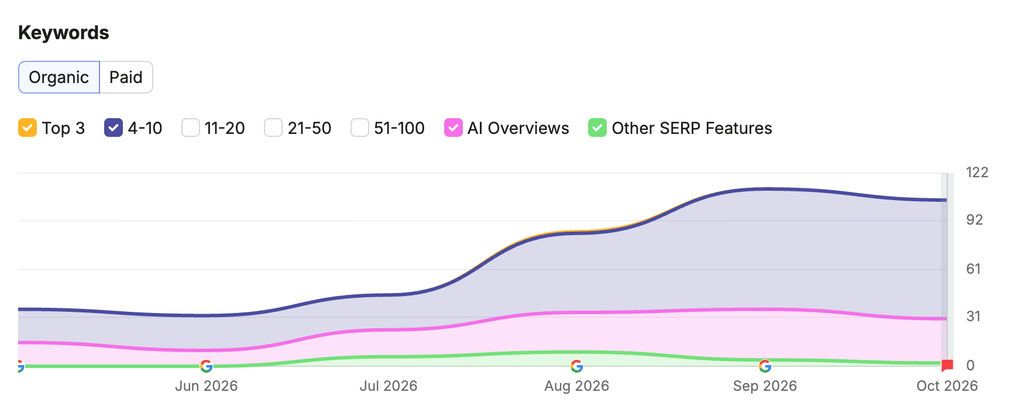
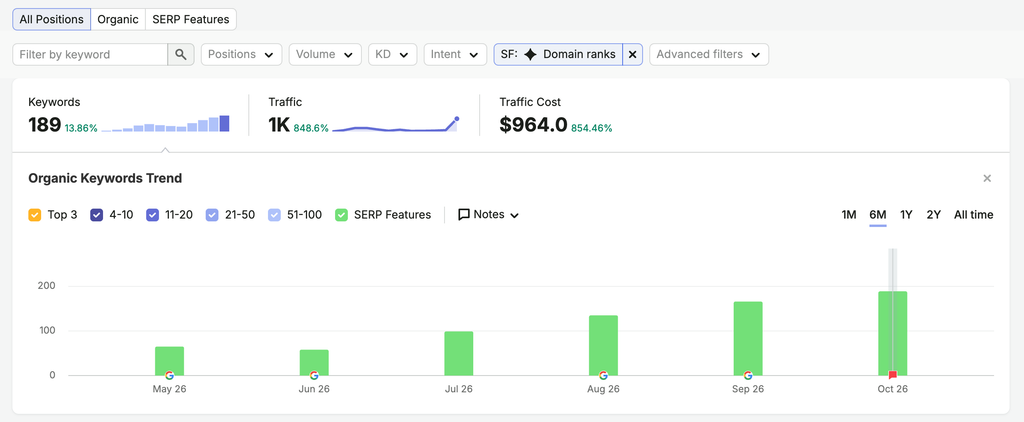
- AI Overviews: Keywords triggering Google AI Overviews across Elevate’s site rose 182%, from 413 in October 2025 to 1,166 in September 2026 (Semrush).
- Organic keywords: Total ranking keywords grew 61% over the same period, from 1,032 to 1,660 (Semrush).
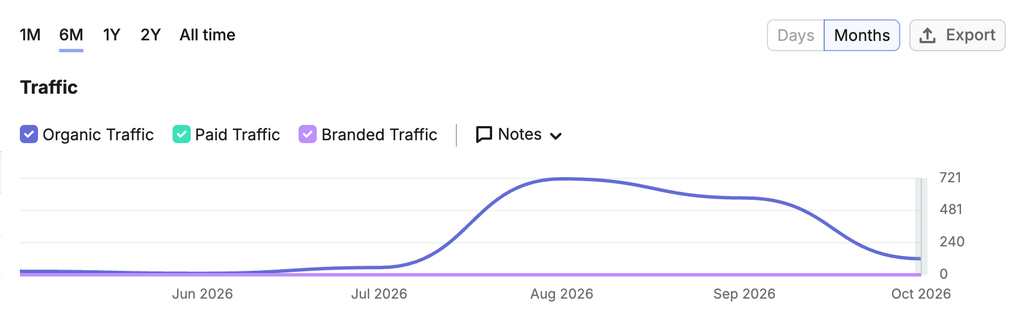
- Organic traffic: Organic sessions from June through September 2026 ran 13% above the same months of 2025 (Google Analytics 4).
- Paver patio cost page: It drew 71% more organic sessions in the five months after its May 2026 refresh than in the five months before (Google Analytics 4). It now ranks in Google positions 4 to 7 for price queries such as “patio pavement price” and “paver cost per square foot” (Semrush).
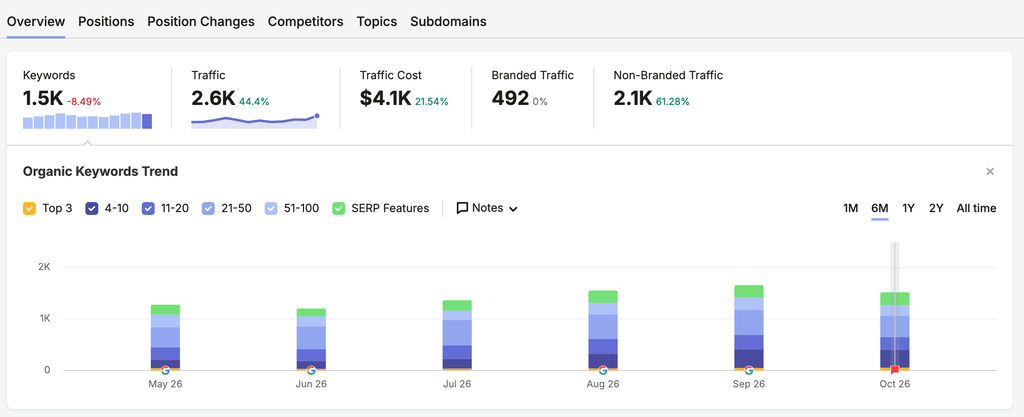
Why a modest lift still matters: You might be thinking, Steph, who cares about a little bit more traffic to one page? The paver page added a few hundred more organic sessions over five months. That sounds like small potatoes, until you consider…
If one of those organic sessions converts into a sale for a 20×20 paver patio, we’re talking $14,000+. If that customer wants to redo their entire backyard, we could be looking at $200,000+. All it takes is one conversion to turn what looks like small potatoes into serious ROI.
Why pay an agency to write content when AI can write for you?
I answer this question with very obvious bias (I have two growing boys to feed after all), but I believe in my bones that partnering with an agency is still valuable, even though Claude can do the drafting.
AI can generate content in seconds, but it’s going to be motel art that could fit any brand and ultimately wastes your time. What makes the difference today is strategy, understanding your customer, and having the guts to put real answers out there.
In manufacturing, industrial contexts, and any vertical that requires consultative selling, that knowledge comes from humans—many of them engineers whose highest and best use of time is not generating content for your website. That’s where an agency comes in.
We can extract that information from your technical teams with a conversation and turn it into content that:
- Makes the sales team’s job easier
- Helps prospects feel more confident in their decision
- Ranks on Google and gets cited by AI
- Drives leads that turn into revenue
- Frees you from AI search FOMO
Let’s do this
Pick one topic your competitors avoid, whether pricing or comparisons, and publish a specific answer. AI content marketing rewards the brands willing to say something concrete. If you want help finding that topic and getting your stakeholders to say yes, then you should talk with us!
Share this article with your network.